Do You Repair Handicap Doors at Businesses and Homes?
Yes, we repair handicap door openers at stores, offices, clinics, schools, churches, apartment buildings, and private homes. Let us know the property type and how many doors are affected.
Handicap Door Repair Kings provides handicap door repair, ADA door opener repair, and push button replacement services in the North Charleston, SC area for both residential and commercial properties, from single swing doors to double entrance doors. Contact us now for a free estimate.
Handicap door repair in North Charleston, SC costs anywhere from $240 to $870 on average for a single door with a common fault like a bad push button, sensor, arm, or adjustment. The price depends on which part failed, the opener brand and parts availability, wired or wireless buttons, door or frame damage, lock hardware tie-ins, and after-hours service.
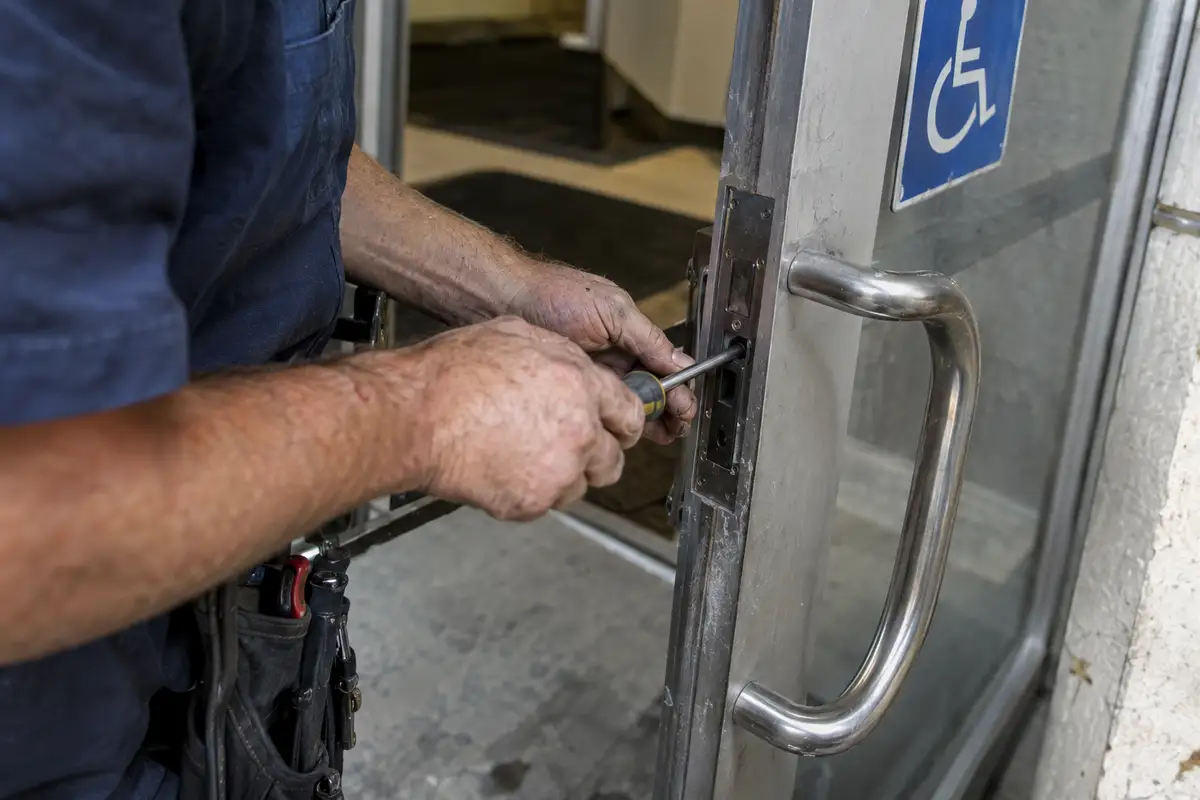
Yes, we repair handicap door openers at stores, offices, clinics, schools, churches, apartment buildings, and private homes. Let us know the property type and how many doors are affected.
Yes, we cover the North Charleston, SC area. Send us the property address and we'll confirm.
Yes, in most cases. We work on the common brands, including Stanley, LCN, Norton, Horton, and Hager. Send a photo of the operator header or its label so we can check parts for your model.
We can usually come within a day or two, and often sooner for a main entrance door that won't open. Some parts have to be ordered, which can add a few days.
Yes, in many cases we can schedule work before opening, after closing, or on a weekend so customers aren't blocked. After-hours visits usually cost more.
We need the address, the opener brand if you can see it, what the door is doing, and whether the buttons are wired or wireless. A short video of the door cycling helps a lot.
No, as long as someone can let us in and show us the power switch or breaker for the operator. We need the door out of use while we work on it.
Yes, but check your lease first. The landlord often owns the entrance doors and openers, so we may need approval from the owner or property manager before we start.
Yes, we diagnose the door and confirm the price before any repair. If we find a worn gearbox or a damaged frame along the way, we stop and talk to you first.
Most button, sensor, and adjustment repairs take one to two hours. Replacing a gearbox or a whole operator usually takes longer, often half a day or more.
The usual causes are a dead button battery, a bad switch in the push plate, a lost wireless signal, a tripped breaker, or the operator set to Off. If the door opens when switched to Hold Open, we look at the buttons first.
Yes, we trace the power from the breaker and switch to the control board. Check that the breaker hasn't tripped and the switch on the header is on before we come.
Yes, we check the transmitter battery, the receiver antenna, and the signal range. On older wireless systems, replacing the transmitter and receiver pair often fixes it.
Yes, we replace push plates on walls, door jambs, and bollard posts. Tell us whether the button is wired or wireless and round or square, so we bring a matching plate and box.
Yes, we replace water-damaged switches and transmitters and can fit weatherproof models. Exterior buttons on posts and walls take the most weather.
Yes, we find what is holding it open. A stuck button, a triggered sensor, the Hold Open setting, or a loose arm are the common causes.
Yes, we usually find a stuck button, a sensor picking up traffic, or interference on a wireless receiver. A door that bounces back open after closing may have a broken spring.
Yes, we adjust the closing speed and latch check, or replace the closing spring if it has broken. A door that slams can hurt someone, so switch the operator off until we get there.
No, not if it slams, swings unexpectedly, or doesn't stop for people. Switch the operator off and post a sign until we get there.
Yes, we adjust the opening speed, back check, and open stop. Binding hinges, a dragging door, or wind on an exterior door can also stop it short, and we check for those too.
Yes, we adjust the operator, free up binding hinges, and check the door in its frame. A low energy opener should still let the door be opened by hand when the power is off.
Yes, noises usually come from a loose arm, worn arm bushings, or a failing gearbox. Tell us when the noise happens, on opening, closing, or both.
Yes, we tighten, realign, or replace push and pull arms and their track or shoe. Arms often bend when someone forces the door against the operator.
Yes, we repair the electric strike or electrified panic bar that releases the latch. If the lock doesn't release, the opener pushes against a locked door, which strains the arm.
Yes, we repair pairs of doors with one or two operators.
Yes, we reset the timing so the inner door opens after the outer one, or rewire the buttons so each door answers its own. Tell us which door fails and from which side.
Yes, we repair home door openers on entry, garage-to-house, and interior doors, along with their remotes and wall pads. Send us the brand and model if you have it.
Yes, we repair the operator, arm, and door after an impact. If the frame is bent or the glass is broken, that part may need its own repair before the opener can work.
Yes, turn the operator off, wait 15 to 30 seconds, and turn it back on. If the fault comes back, call us and don't open the header or the electronics.
No, don't spray anything into the header. Oil there collects dirt.
Yes, in most cases. The ADA doesn't require automatic doors, but businesses must keep accessible features working, with short outages for repairs allowed. We fix the door, and your local building official can say how the rules apply.
Yes, AAADM recommends an inspection by a certified inspector after installation and every year after. Ask us when you call and we can set it up with the repair visit.
Push the button from both sides and watch that the door opens smoothly, stays open long enough to pass through, and closes without slamming. Call us if anything seems off.
Yes, we replace the yellow Automatic Caution Door sign and the blue Activate Switch to Operate decals on button-operated doors.
Replacement is worth it when the gearbox or control board fails on an old unit with discontinued parts. For a bad button, sensor, or arm, we recommend repair.
Yes, we can swap in a new operator. Replacement typically runs $800 to $3,500 with installation, and many units fit the existing door and wiring.
Yes, we cycle the door, check opening and closing speed and force against ANSI/BHMA A156.19, and test the buttons from both sides before we leave.
